Why teams look for alternatives
Businesses and teams start searching for Deepgram alternatives when they require:
- Cheaper, more predictable transcription pricing at scale
- Better accuracy on real-world conversational audio, including overlapping speakers, interruptions, accents and background noise
- Intelligence derived from the audio itself, beyond the transcript (e.g., emotion, accent and deepfake detection), without relying on multiple vendors
- A different balance of features, such as deployment options, language coverage, cloud-ecosystem fit or voice generation
Below are alternatives to Deepgram that specialize in one or more of these areas. We’ll discuss seven competitors that provide STT services:
- Modulate Transcribe
- AssemblyAI
- Speechmatics
- Google Cloud Speech-to-Text
- Amazon Transcribe
- OpenAI Whisper
- ElevenLabs
What is Deepgram?
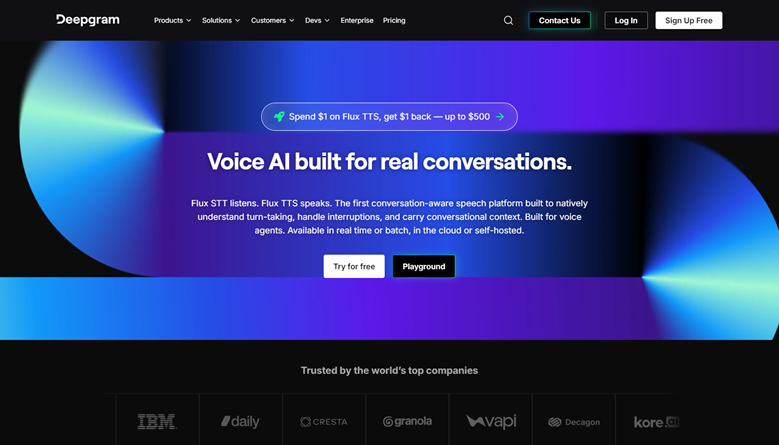
Deepgram is a developer-oriented voice AI platform that offers speech-to-text, text-to-speech, and voice agent APIs. The company specializes in the infrastructure needed for real-time voice applications that require low latency.
Deepgram offers the following speech-to-text models:
Nova-3 (Monolingual & Multilingual)
General purposeDeepgram’s general-purpose transcription model for both streaming and pre-recorded audio. Deepgram advertises that its Nova models can recognize over 45 languages.
- Streaming + batch
- 45+ languages
Flux
Voice agentsConversational speech recognition model designed specifically for voice agents, with turn detection built into the model. Launched for English in October 2025; Flux Multilingual reached general availability in April 2026 with 10 languages and native code-switching.
- Streaming
- Built-in turn detection
Deepgram’s key speech-to-text features include streaming and batch transcription, speaker diarization, keyterm prompting, multilingual transcription, code-switching between languages, smart formatting options, and PII redaction.
Beyond standalone STT, Deepgram also sells Aura-2 and Flux voices for text-to-speech, a Voice Agent API that combines STT, an LLM, and TTS into one API, as well as audio intelligence capabilities like summarization, topic detection, and sentiment analysis.
Deepgram pricing
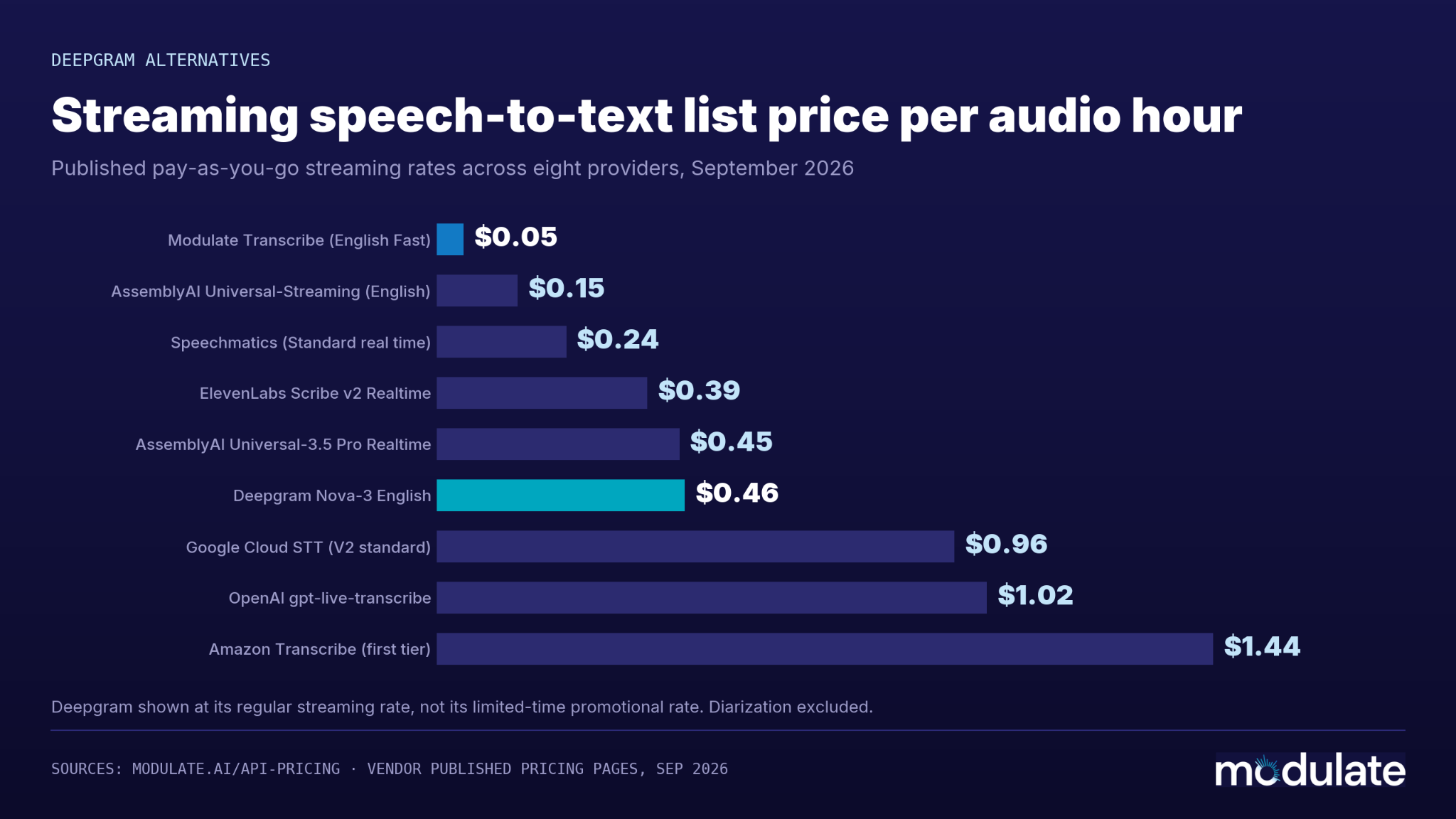
Deepgram offers speech-to-text pricing starting at roughly $0.26 to $0.47 per hour of audio, depending on your model choice, language mode and whether you stream or pre-record your audio. On Deepgram's pricing page, several streaming plans are listed as "limited-time promotional," so we have included the regular price below as well.
| Model | Mode | Current pay-as-you-go | Regular rate (if promo) |
|---|---|---|---|
| Nova-3 Monolingual | Streaming | $0.0048/min (~$0.29/hr) | $0.0077/min (~$0.46/hr) |
| Nova-3 Multilingual | Streaming | $0.0058/min (~$0.35/hr) | $0.0092/min (~$0.55/hr) |
| Flux English | Streaming | $0.0065/min (~$0.39/hr) | $0.0077/min (~$0.46/hr) |
| Flux Multilingual | Streaming | $0.0078/min (~$0.47/hr) | — |
| Nova-3 Monolingual | Pre-recorded | $0.0043/min (~$0.26/hr) | — |
| Nova-3 Multilingual | Pre-recorded | $0.0052/min (~$0.31/hr) | — |
Optional features are available for an additional cost. Speaker diarization adds about $0.12/hour for streaming audio (it's included for pre-recorded audio). PII redaction also adds about $0.12/hour. Keyterm prompting is $0.08/hour additional. New customers are given a $200 credit. The Growth plan ($4,000+/year prepaid) lowers per-minute rates by roughly 12-17%, depending on the model. For example, pre-recorded Nova-3 drops from $0.0043 to $0.0036/min, and streaming Nova-3 from $0.0048 to $0.0042/min.
These costs add up at scale. The difference between a service that is approximately $0.30/hour and a lower-cost service is $10,000 hours/month ($0.10/hour difference).
Why consider a Deepgram alternative?
Most teams look for Deepgram alternatives for one of four reasons:
- CostPricing by the transcribed hour differs 10x or more across the market. That spread can often make or break the business case for contact centers, meeting platforms and social apps transcribing hundreds of thousands of hours per month.
- Conversational speechAccuracy benchmarks on clean, read speech fail to capture how well a model handles the crosstalk, interruptions, accents and background noise present in real conversation. It’s the conversational workload where commercial ASR error rates diverge most.
- Audio accessA transcript loses all information about tone, emotion, vocal stress and whether the speaker was even a human. Teams who need to tap into those signals will often resort to integrating a separate audio API.
- Feature tradeoffsDeepgram's roadmap leans toward real-time voice applications. If your priorities are broader language coverage, tight integration with a specific cloud provider, on-device or air-gapped deployment, or best-in-class voice generation, another provider may be a better fit.
1. Modulate Transcribe
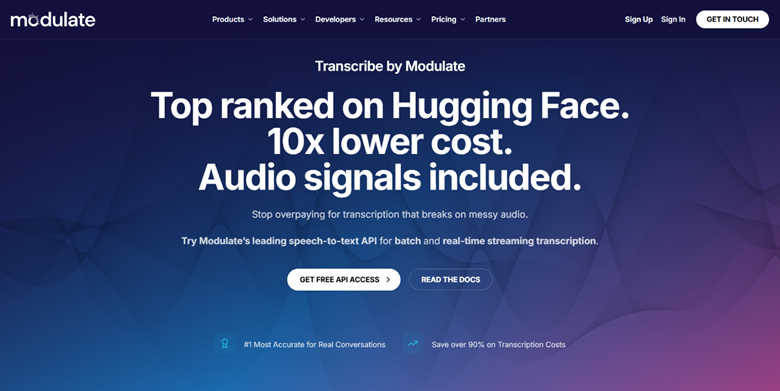
Modulate Transcribe is the top Deepgram alternative for businesses and teams that require human-level transcription of messy real-world conversations at a lower cost. Modulate Transcribe is part of Velma, Modulate’s entire suite of audio-native voice intelligence models. The Transcribe model is trained on over 500 million hours of real-world conversational audio data.
What we're comparing: Modulate Transcribe vs. Deepgram
This article compares Modulate Transcribe, Modulate's speech-to-text API, with Deepgram's speech-to-text models, Nova-3 and Flux. That's our direct, like-for-like comparison.
We mention Velma because Transcribe is part of that larger system, but Velma is really in a different product category than Deepgram. Here’s how the pieces fit together:
- Velma is Modulate’s suite of audio-native voice intelligence AI models. Velma is an Ensemble Listening Model (ELM), a machine learning architecture that intelligently leverages many specialized models — each trained on one signal such as emotion, stress, conduct or synthetic speech — through a single unified orchestration layer.
- Modulate Transcribe is Modulate’s speech-to-text API. It is one of the Dynamic Ensemble Blocks that make up Velma’s ELM, but can be purchased and used independently. On some Modulate pages you’ll see it referred to as “Velma Transcribe” — it is the same product.
- Detection Add-Ons/APIs (emotion, accent, PII/PHI tagging/redaction, deepfake detection, etc.) are individual Velma models. Some attach to a Transcribe call as low-cost add-ons, while others such as deepfake detection have their own separate APIs.
- Velma Triage unifies Velma’s entire ensemble for full conversation understanding, capturing behavior across 150+ configurable attributes including speaker roles, topics and sentiment, and producing call summaries. It is available through Modulate’s enterprise voice AI platform.
| Modulate product | What it does | Pay-as-you-go price | Closest Deepgram counterpart |
|---|---|---|---|
| Modulate Transcribe | Batch and streaming speech-to-text | $0.025-$0.06/hour | Nova-3, Flux |
| Transcribe add-ons | Emotion, accent, PII/PHI tagging on the transcript | $0.01-$0.02/hour each | Redaction, entity detection add-ons (no emotion or accent equivalent) |
| Deepfake Detection | Flags AI-generated and cloned voices | $0.25/hour | None |
| Velma Triage | Conversation understanding: behaviors, roles, topics, summaries | $0.75-$1.25/hour | Audio Intelligence (summaries, topics, sentiment, intent) |
The prices referenced are taken from Modulate’s public API pricing page. If this article references Modulate's transcription price or accuracy, it is specifically referring to Transcribe by itself. Emotion, accent and deepfake detection are additional Velma services you can add to Transcribe; they are not included in the base transcription price.
Key capabilities
- Batch or REST and real-time streaming API over WebSocket with sub-second partial transcripts
- Transcribe in 70+ languages and their various dialects
- Speaker diarization at no additional cost
- Word-level timestamps and confidence levels
- Optional PII/PHI tagger ($0.02/hour), emotion detection with 20+ emotions ($0.02/hour) and accent detection ($0.01/hour) from Modulate's Velma model family
- Total redaction of PII/PHI data from both the transcript and audio itself as a separate endpoint ($0.05/hour for batch, $0.08/hour for streaming)
- Deepfake detection is its own Velma API ($0.25/hour) that can be run against the same audio file. It is not included in Transcribe.
| Modulate Transcribe model | Batch | Streaming |
|---|---|---|
| English Fast | $0.025/hour | $0.05/hour |
| Multilingual | $0.03/hour | $0.06/hour |
| Multilingual Fast | $0.03/hour | — |
Where Modulate stands out from Deepgram
Cost. On a like-for-like basis with Deepgram's pay-as-you-go pricing, Modulate Transcribe costs $0.025/hour for English batch transcription, versus $0.26/hour with Deepgram Nova-3, and $0.03/hour for multilingual batch, versus $0.31/hour. For English streaming, Modulate charges $0.05/hour versus Deepgram's promotional $0.29/hour rate (roughly $0.46/hour at its regular rate). For multilingual streaming, it's $0.06/hour versus $0.35/hour promotional ($0.55/hour regular).
| Workload | Modulate Transcribe | Deepgram Nova-3 | Modulate savings |
|---|---|---|---|
| English, batch | $0.025/hour | $0.26/hour | ~90% |
| Multilingual, batch | $0.03/hour | $0.31/hour | ~90% |
| English, streaming | $0.05/hour | $0.29/hour promo ($0.46 regular) | 83% (89%) |
| Multilingual, streaming | $0.06/hour | $0.35/hour promo ($0.55 regular) | 83% (89%) |
| English streaming with diarization | $0.05/hour | $0.41/hour promo | ~88% |
Conversational accuracy. Modulate Transcribe's multilingual model is currently ranked #3 on Hugging Face's Open ASR Leaderboard (as of September 2026), including having the second-lowest word error rate on AMI, a benchmark dataset that contains noisy real-world multi-speaker meetings.
Audio intelligence. Because Transcribe runs natively inside Velma, you can request emotion, accent, and PII/PHI analysis for the same audio clip alongside transcription for a few extra cents an hour. You can also run deepfake detection against that same audio. Deepgram's audio intelligence is applied after transcription (summaries, topics, sentiment, intent) and doesn't include options for emotion, accent, or synthetic voice detection.
Included capabilities. Diarization is included on every request to Modulate; with Deepgram you pay extra for diarization on streaming audio.
Best for
- Contact centers
- Voice AI applications
- Gaming and social platforms
- Trust and safety
- Fraud and deepfake detection
- High-volume conversational transcription
- Noisy or overlapping speech
- Any organization where transcription cost is a major consideration
2. AssemblyAI
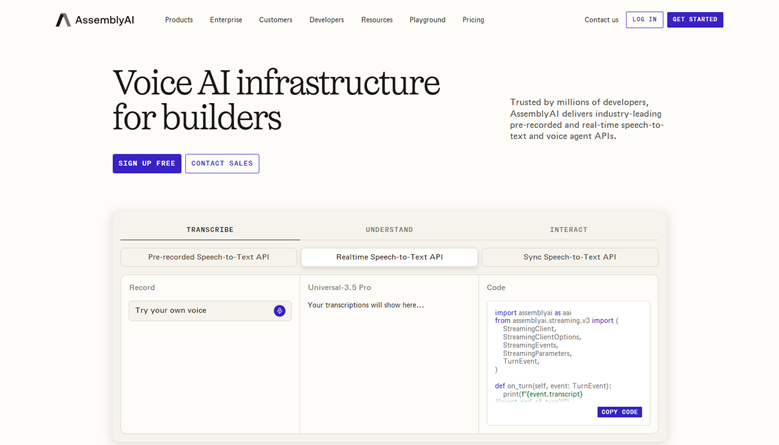
AssemblyAI is a speech AI company building developer APIs for transcription and speech understanding. Their Universal family of models consists of models for batch and real-time transcription. They recently launched into voice-agent infrastructure with two products: Voice Agent API, and LLM Gateway.
Key capabilities
- Batch transcription
- Streaming transcription
- Speaker diarization
- Keyterm prompting
- Natural-language prompting
- Language detection and code-switching
- PII redaction
- Sentiment analysis
- Entity detection
- Summarization
AssemblyAI pricing
$0.21/hour for pre-recorded audio using Universal-3.5 Pro, which starts at $0.15/hour with Universal-2; streaming rates start at $0.15/hour with Universal Streaming and go up to $0.45/hour with Universal-3.5 Pro Realtime. Voice Agent API costs a flat $4.50/hour. Speaker diarization is charged extra for streaming.
AssemblyAI vs. Deepgram
Both AssemblyAI and Deepgram are targeted at developers building production speech applications. Deepgram focuses more on low-latency streaming and voice-agent infrastructure. AssemblyAI places more emphasis on speech understanding and LLM-focused features built on top of the transcript. If you're looking for transcription and downstream language understanding in one API, AssemblyAI may be the better fit. If real-time voice-agent use cases are your top requirement, Deepgram is likely a better choice.
3. Speechmatics
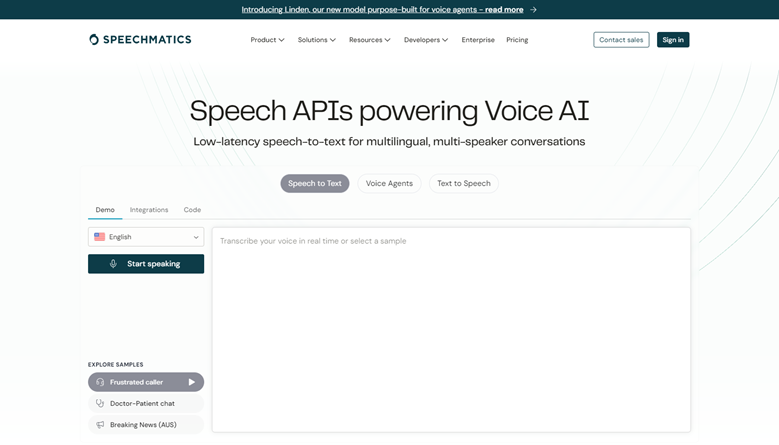
Speechmatics is one of the longer-established players in speech recognition, with support for 55+ languages. It offers a cloud API as well as some of the most flexible self-deployment options available: on-premises, on-device and fully air-gapped.
Key capabilities
- 55+ languages supported
- Batch and real-time transcription
- Speaker diarization (built-in)
- Automatic language identification
- Custom dictionaries up to 1,000 words
- On-premises and edge deployment options
- Text-to-speech
- Voice agents
Speechmatics pricing
Speechmatics' Pro plan starts at $0.129/hour for batch transcription with Melia 1, its multilingual model (batch only). Batch Standard is $0.24/hour and Batch Enhanced is $0.40/hour. Real-time transcription is $0.24/hour for Standard and $0.43/hour for Enhanced. New accounts get $100 in free credit, no card required. Usage above 500 hours per month gets an automatic 20% discount.
Speechmatics vs. Deepgram
Both Speechmatics and Deepgram have production-ready batch and streaming STT. Speechmatics shines when multilingual coverage and deployment flexibility matter most, or when your organization is regulated and must ensure audio never leaves your infrastructure. Deepgram leans more into infrastructure for developers building real-time conversational AI and voice agents.
4. Google Cloud Speech-to-Text
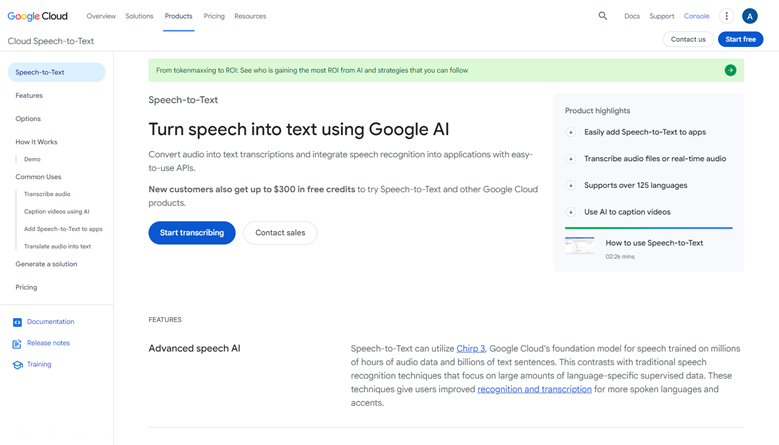
Google Cloud Speech-to-Text is Google Cloud's speech recognition service. It integrates tightly with the rest of Google Cloud, so it can be the easiest option if your organization is already committed to Google Cloud. It is built around the Chirp model family.
Key capabilities
- Broad language coverage (around 85 to 125+ languages and locales, depending on the model)
- Batch and streaming recognition
- Automatic punctuation
- Speaker diarization
- Speech adaptation
- Native integrations with enterprise Google Cloud services (IAM, VPC Service Controls, regional data residency, etc.)
Google Cloud Speech-to-Text pricing
Google Cloud Speech-to-Text's V2 API pricing is $0.016/minute (approximately $0.96/hour) for standard recognition. The pricing goes down at higher volume tiers. There is also a Dynamic Batch tier for jobs that can tolerate up to 24 hours of waiting — approximately $0.003-$0.004/min (around $0.18-$0.24/hour) as of this writing.
Google Cloud Speech-to-Text vs. Deepgram
Google has a much larger cloud infrastructure and some of the broadest language coverage. Deepgram is built specifically as a voice AI developer platform, so it typically makes sense to go with Deepgram if you're building a dedicated real-time voice app. Google makes more sense if you want to simplify your architecture and your whole stack is on Google Cloud (or will be), since transcription will be just one piece of that larger ecosystem.
5. Amazon Transcribe
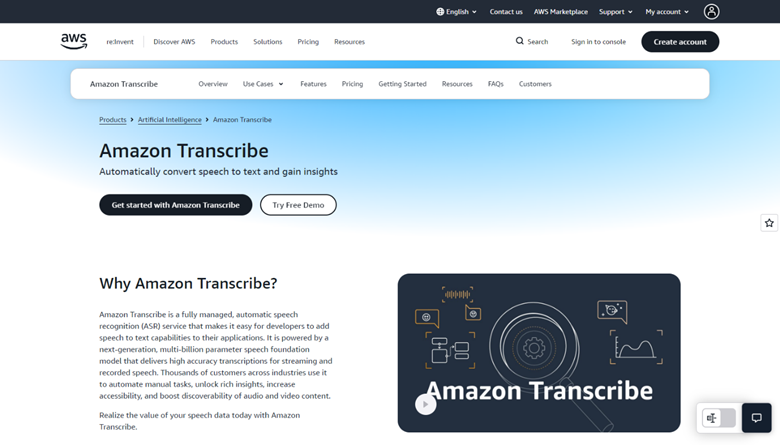
Amazon Transcribe is AWS’s managed automatic speech recognition service. It integrates seamlessly with AWS storage, analytics, contact center (Amazon Connect), and AI tools.
Key capabilities
- Batch and streaming transcription
- Speaker and channel identification
- Custom vocabulary
- PII identification and redaction
- Call Analytics for contact centers
- Transcribe Medical
- Support for over 100 languages
Amazon Transcribe pricing
Standard transcription pricing starts at $0.024/min (about $1.44/hour) for the first 250,000 minutes a month, with tiered discounts at higher volumes. Call Analytics and Medical are priced separately and cost more.
Amazon Transcribe vs. Deepgram
AWS has a vastly larger infrastructure ecosystem. Deepgram has far less infrastructure but specializes in voice AI and real-time conversational use cases. Amazon Transcribe may simplify architecture for organizations with existing large AWS footprints, and Call Analytics extends its value to contact centers. However, at its first-tier list price, Amazon Transcribe costs several times more per hour than Deepgram and more than 20 times more than Modulate.
6. OpenAI Whisper
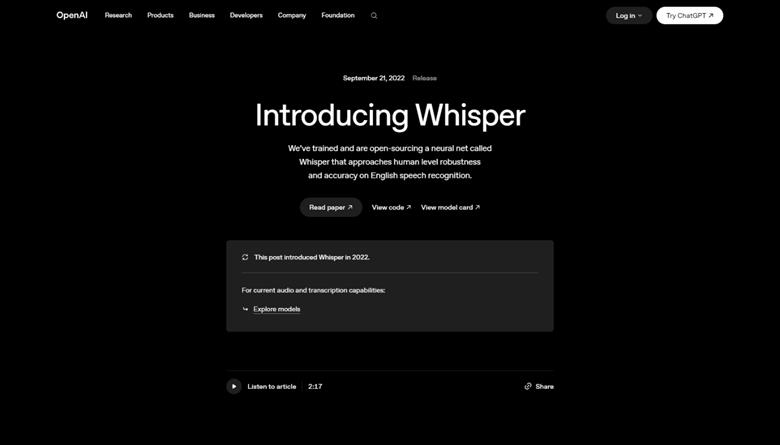
OpenAI Whisper continues to be one of the most popular speech recognition models for multilingual support and self-hosted transcription use cases. OpenAI has since introduced newer managed speech-to-text models outside of the Whisper API: gpt-4o-transcribe, gpt-4o-mini-transcribe, and, in July 2026, gpt-transcribe for recorded audio and gpt-live-transcribe for real-time streaming.
Key capabilities
- Broad multilingual support (99+ languages)
- Open-source Whisper models allow for self-hosting
- Managed API models are also available
- Can translate non-English speech to English via whisper-1
- Many third-party tools and implementations in the ecosystem
OpenAI Whisper pricing
Self-hosted Whisper has no per-minute pricing, but GPU and usage costs apply. Managed API pricing is $0.006/min ($0.36/hour) for whisper-1 and gpt-4o-transcribe, $0.003/min ($0.18/hour) for gpt-4o-mini-transcribe, and $0.0045/min ($0.27/hour) for gpt-transcribe. For real-time streaming, gpt-live-transcribe and gpt-realtime-whisper both cost $0.017/min ($1.02/hour).
Deepgram vs. OpenAI Whisper
Deepgram has much lower latency, but Whisper offers more customization if your organization is willing to run and maintain the models itself. Self-hosting requires your own infrastructure, operations to optimize and scale models, latency management, and maintenance. Deepgram provides managed infrastructure built and scaled for production speech and voice-agent workloads.
7. ElevenLabs
ElevenLabs may be best known as an AI voice generation/text-to-speech platform, but it recently entered the speech-to-text space with its Scribe models. ElevenLabs is worth mentioning here because it’s relevant for any use cases requiring both speech input and generated voice output.
Key capabilities
- Speech-to-text (batch: Scribe v2, realtime Scribe v2 at ~150 ms latency)
- Over 90 languages supported
- Speaker diarization (up to 32 speakers)
- Keyterm prompting
- Entity detection
- Text-to-speech
- Voice cloning
- Conversational voice agents
ElevenLabs pricing
ElevenLabs pricing starts at $0.22/hour for Scribe v2 and $0.39/hour for Scribe v2 Realtime. Additional add-ons cost $0.05/hour for keyterm prompting and $0.07/hour for entity detection.
ElevenLabs vs. Deepgram
Deepgram and ElevenLabs now both offer products across multiple areas of the voice AI stack, but they entered the space from opposite directions. Deepgram was founded with speech recognition as its core use case, and its real-time voice infrastructure is still one of its strongest products. ElevenLabs was founded as a text-to-speech provider, and its TTS/generative voice products are among the best. The best service for you depends on which direction matters more: speech recognition and real-time infrastructure, or generated voice.
How to choose the best Deepgram alternative
Four considerations will help you choose the best Deepgram alternative for your needs.
- Test accuracy on your own audioPublished benchmarks are useful for shortlisting, but not the final verdict. Feed a statistically valid sample of actual calls, meetings or game chat (including noisy and overlapped sections) to each contender and compare WER.
- Compare total transcription costsModel your true costs at anticipated volume, including base rate, streaming vs. batch fees, and add-ons. Account for introductory pricing that will change.
- Consider your needs beyond textSpeaker emotion, accent detection, PII/PHI redaction of the audio or synthetic-voice detection may influence which vendor you select.
- Evaluate latency and deploymentVoice agents need low latency for natural turn-taking, while post-call analytics can use lower-cost batch APIs. If audio can't leave your infrastructure, shortlist providers with on-premises options.
| Provider | Batch price (per audio hour) | Streaming price (per audio hour) | Deployment |
|---|---|---|---|
| Modulate Transcribe | $0.025-$0.03 | $0.05-$0.06 | Cloud API |
| Deepgram Nova-3 | $0.26-$0.31 | $0.29-$0.35 promo ($0.46–$0.55 regular) | Cloud, self-hosted |
| AssemblyAI | $0.15-$0.21 | $0.15-$0.45 | Cloud API |
| ElevenLabs Scribe v2 | $0.22 | $0.39 | Cloud API |
| Speechmatics | $0.129-$0.40 (Melia 1 to Enhanced) | $0.24-$0.43 (Standard to Enhanced) | Cloud, on-prem, on-device, air-gapped |
| OpenAI | $0.18-$0.36 managed; self-host Whisper free | $1.02 (gpt-live-transcribe or gpt-realtime-whisper) | Cloud API, or self-hosted Whisper |
| Google Cloud STT (V2) | $0.18-$0.96 (Dynamic Batch to Standard) | $0.96 | Google Cloud |
| Amazon Transcribe | $1.44 | $1.44 | AWS |
Why Modulate is the best Deepgram alternative
If your business requires intelligence from voice (not just transcription), Modulate is Deepgram’s best alternative. Here’s how they compare.
- Affordable transcription at scale. Modulate Transcribe costs $0.025-$0.03/hour for batch audio and $0.05-$0.06/hour for streaming, compared with Deepgram Nova-3 at $0.26-$0.31/hour for batch and $0.29-$0.35/hour for streaming ($0.46-$0.55/hour at Deepgram's regular, non-promotional rates).
- Accurate with interruptions and background noise. Trained on over 500 million hours of conversational audio, its multilingual model ranks #3 on Hugging Face's Open ASR Leaderboard and has the second-lowest word error rate on AMI.
- Receive emotion and accent data along with your transcript. Add-ons integrate with a Transcribe request, so you don’t need to send audio to another vendor for these signals.
- Tested on public datasets. Through July 2026, Modulate ranked first out of 88 ASR models on Hugging Face’s Open ASR Leaderboard. View the complete Modulate Transcribe vs. Deepgram comparison and visit Modulate’s benchmarks page for more data.
- Consolidate your speech tools. Build deepfake detection, audio event detection, and comprehensive conversation understanding with Modulate’s Velma model family, all from the same API account.
- Redacts PII/PHI in real time — from the transcript and from the actual audio stream.
- Works with the audio, not transcripts. Velma processes the original audio as it happens, so signals like tone, stress, and AI voice aren’t filtered out.
- Specialized models working in tandem. Velma coordinates many purpose-built models, each tuned for one signal, instead of asking one general model to do everything.
Deepgram excels at use cases where latency is the primary concern, where on-premises or cloud self-hosting is required, or where customers want STT, TTS and digital agent “connectors” from one vendor. Otherwise, if you value cheap, accurate transcription, fidelity with real-life conversations and accurate intelligence from actual audio rather than the transcript, Modulate is your best option.