Overview
However, AssemblyAI doesn’t meet the needs of every production workload. Typically, developers and teams start evaluating alternatives when they need:
- Reduced transcription costs at scale
- Higher accuracy on messy, real-world conversational audio
- Better performance with overlapping speakers, interruptions, accents, and background noise
- Intelligence derived directly from the audio, rather than just the transcript
- Predictable economics for processing massive amounts of audio
There are a number of alternatives to AssemblyAI that provide unique tradeoffs on accuracy, latency, language coverage, deployment flexibility, and price. This buying guide compares seven of those options:
- Modulate
- Deepgram
- Speechmatics
- Google Cloud Speech-to-Text
- Amazon Transcribe
- OpenAI Whisper
- ElevenLabs
What is AssemblyAI?
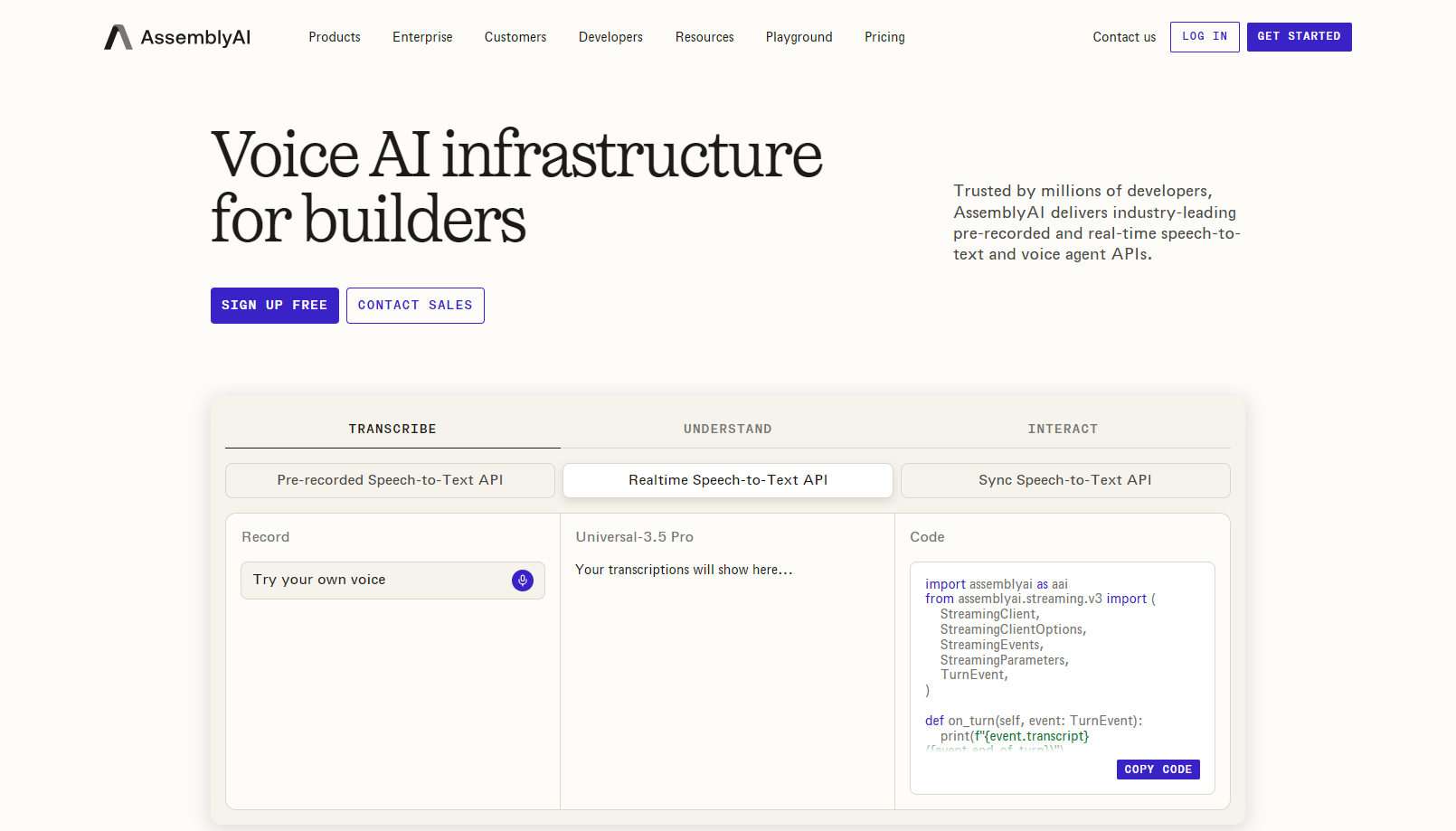
AssemblyAI provides a speech AI platform that is API-first. AssemblyAI has the capabilities needed for both pre-recorded and real-time use cases. Transcription is performed by models from the Universal model family.
Features in addition to core speech-to-text include:
- Speaker diarization and speaker identification
- Keyterm prompting and natural-language prompting
- Code switching and language detection
- PII redaction for text and audio files
- Sentiment analysis and entity detection
- Summarization and other speech-understanding capabilities
AssemblyAI has branched out from simply offering standalone transcription with products like the Voice Agent API, Dictation API and an LLM Gateway for routing transcripts to third-party language models.
AssemblyAI Pricing
AssemblyAI bills pay-as-you-go pricing on a per-hour-of-audio basis (or per connected session hour for streaming). There are no minimum usage requirements, and high-volume customers can request custom pricing tiers. Currently, AssemblyAI's core transcription models are priced as follows:
| Product | Price per hour |
|---|---|
| Universal-3.5 Pro (pre-recorded) | $0.21 |
| Universal-2 (pre-recorded) | $0.15 |
| Universal-3.6 Pro Realtime | $0.45 |
| Universal-Streaming (English only) | $0.15 |
| Universal-Streaming Multilingual | $0.15 |
| Sync API | $0.45 |
| Dictation API | $0.62 |
| Voice Agent API | $4.50 |
Most additional features are charged as add-ons to the base transcription price:
| Add-on | Price per hour |
|---|---|
| Speaker diarization | $0.02 (pre-recorded), $0.12 (streaming) |
| Keyterm prompting (Universal-3.5 Pro) | $0.05 |
| Prompting | $0.05 |
| Medical Mode | $0.15 |
| Speaker identification | $0.02 (low effort), $0.10 (medium effort) |
| Translation | $0.06 |
| Custom formatting | $0.03 |
| Entity detection | $0.08 |
| Sentiment analysis | $0.02 |
| Key phrases | $0.01 |
| Topic detection | $0.15 |
| Summarization | $0.02 (low effort), $0.07 (medium effort) |
| PII audio redaction | $0.05 |
| PII text redaction | $0.08 (pre-recorded), $0.12 (streaming) |
| Content moderation | $0.15 |
Add-ons are cumulative. If you were transcribing recorded calls for a contact center using Universal-3.5 Pro with diarization and audio/text redaction of PII, it would cost $0.36 per hour before adding sentiment analysis or summarization. Multichannel audio is also charged by channel, so for example, a one-hour stereo call would be billed as two hours of audio.
Why Consider an AssemblyAI Alternative?
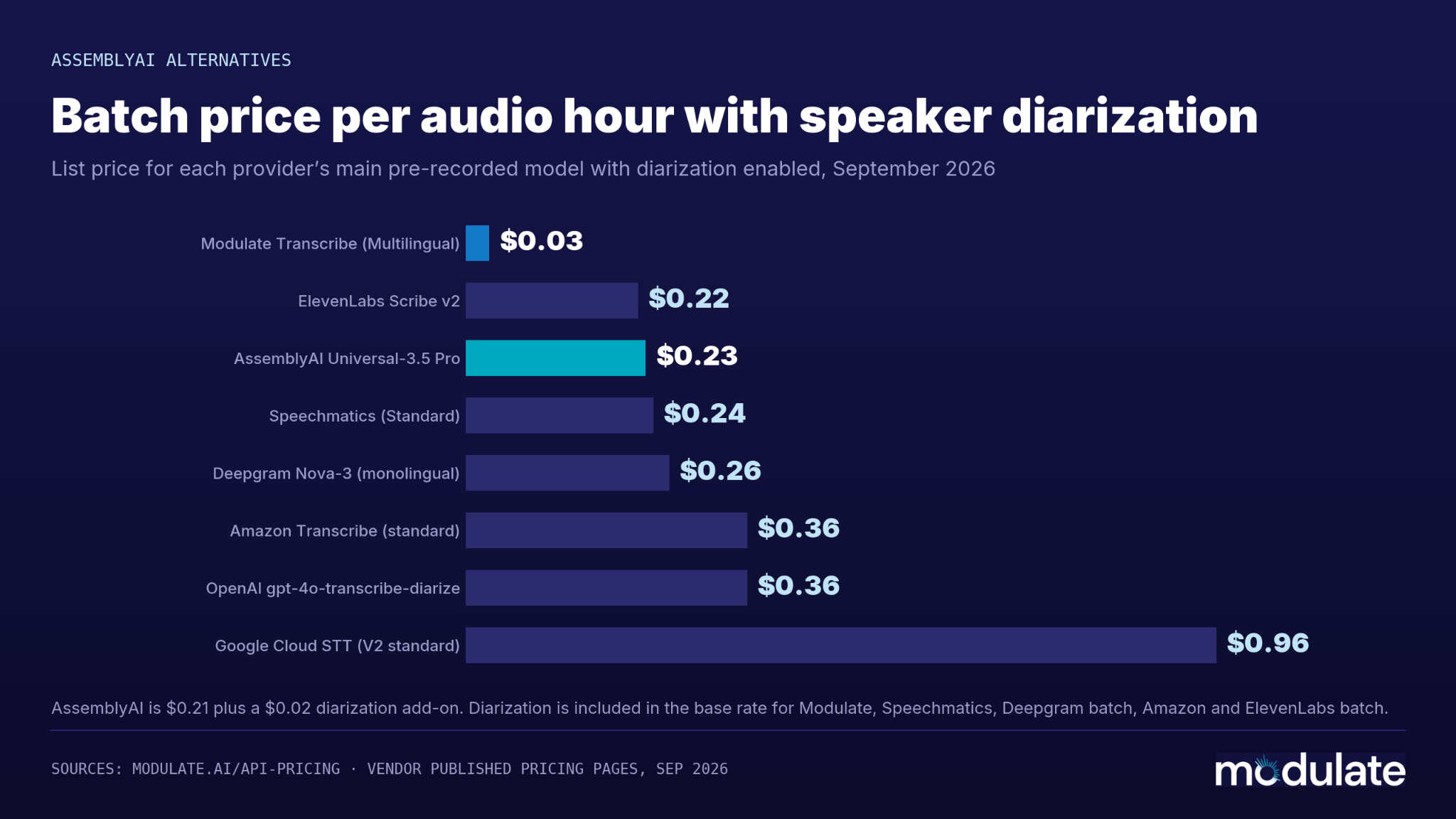
Lower transcription costs. A few cents per hour can become significant at scale, especially when add-ons are applied to the base price. Those transcribing thousands of hours per month often look for less expensive alternatives.
Better performance on real-world conversations. Accuracy benchmarks that use clean, read speech won't tell you how well a model will handle overlaps, interruptions, accents, and poor phone lines. When your audio resembles a contact center or voice channel more than a recording studio, you care about accuracy on your audio.
More information from the original audio. Transcript-first analysis misses what the words don't convey: tone, emotion, stress levels, or even if the voice is real or synthetic. Audio-first providers can analyze the audio waveform directly.
Variations in pricing and features. Some platforms include features in the base price that others charge extra for. Some specialize in on-premises deployment. Others tie into a larger cloud platform you may already be using.
7 Top AssemblyAI Alternatives
Modulate Transcribe
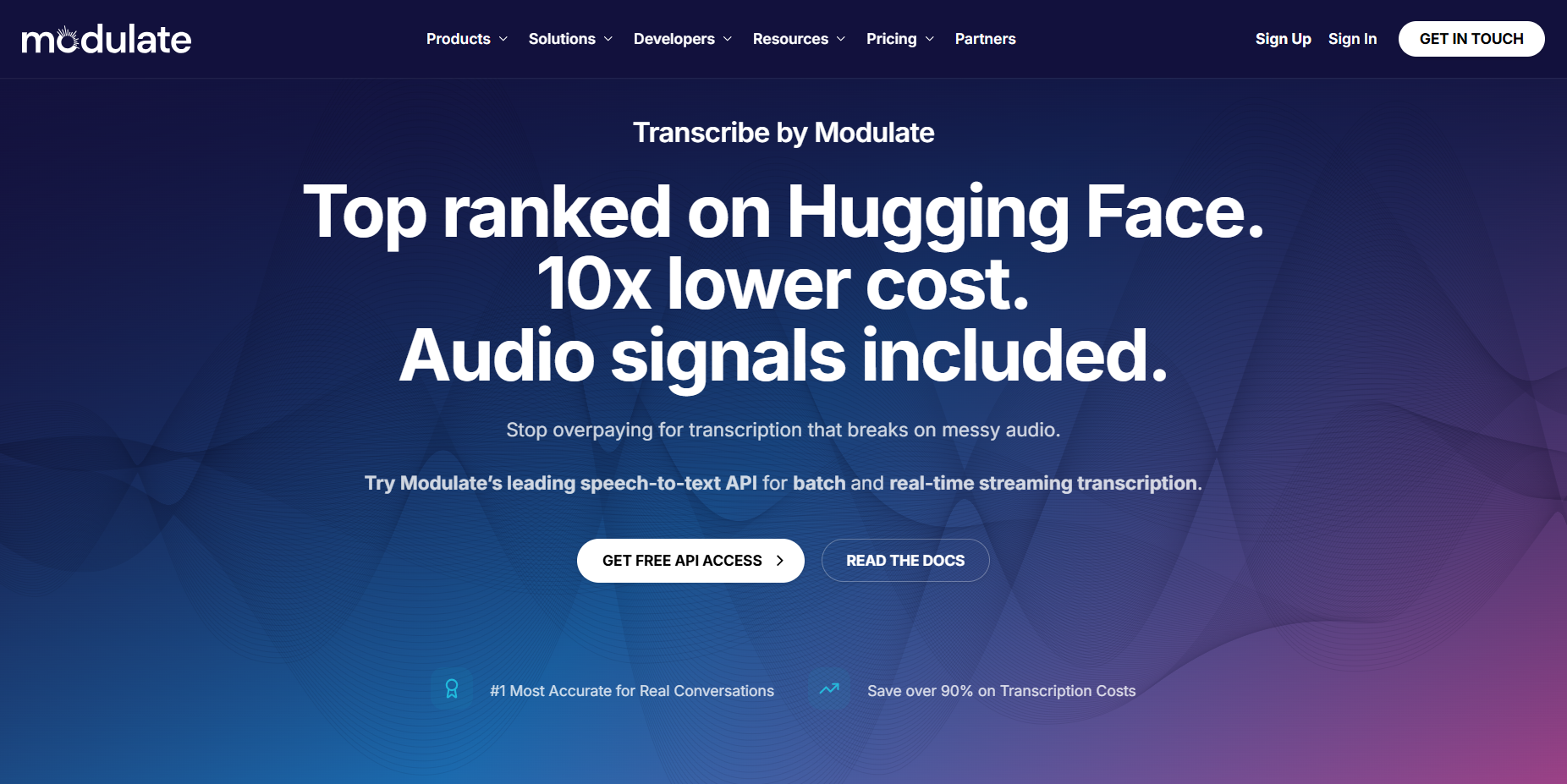
Modulate is an audio-native voice intelligence platform built around understanding real world voice conversations. Our platform consists of purpose-built models that can be deployed individually or together so customers can start with transcription and gradually add other capabilities as needed.
Two parts of that platform are relevant here, and we should clarify them before continuing:
- Modulate Transcribe is Modulate’s speech-to-text model. It’s purpose-built for real-world conversational audio. Think of Transcribe as the direct apples-to-apples alternative to AssemblyAI’s transcription models.
- Velma is Modulate’s Ensemble Listening Model (ELM). Velma orchestrates Transcribe with other purpose-built models to identify things like fraud, intent, emotion, stress and synthetic speech directly from audio instead of sending an LLM over a transcript. Velma is a conversation-understanding layer, so compare it to other transcript-plus-LLM analysis pipelines, not a speech-to-text API.
Since Transcribe is one of the building blocks of Velma, customers that begin their journey with Transcribe are already set up to add audio-derived intelligence later should they choose to do so without having to switch vendors or integrate separate APIs.
Key capabilities include:
- Batch transcription using REST, real-time streaming using WebSocket with latency under a second
- Models support 70+ languages, with an English-only Fast model and a Multilingual Fast model
- Speaker diarization as part of the base cost
- Timestamps in transcription
- Optional emotion detection (supports 20+ emotions), accent detection, and PII/PHI tagging add-ons (emotion and accent detection are batch-only)
- PII/PHI redaction for both audio stream and transcript (covers 100+ PII and PHI entity types)
Modulate also offers related standalone models through the same API, such as deepfake detection, language detection, and audio event detection, which detects non-speech sound in a recording such as laughter, coughing and background noise.
Modulate Pricing
Modulate publishes self-serve, pay-as-you-go pricing per hour of audio. There are volume discounts available for annual commitments. To compare apples-to-apples, here’s Transcribe alongside AssemblyAI’s high-end model, with speaker diarization enabled:
| Transcription with diarization | Modulate Transcribe (Multilingual) | AssemblyAI |
|---|---|---|
| Batch, per hour | $0.03 (diarization included) | $0.23 (Universal-3.5 Pro: $0.21 + $0.02 diarization) |
| Streaming, per hour | $0.06 (diarization included) | $0.57 (Universal-3.6 Pro Realtime: $0.45 + $0.12 diarization) |
Modulate’s Transcribe model costs less if you only need English-language processing, at $0.025 per hour for batch and $0.05 per hour for streaming.
Other capabilities are priced separately, so they should be compared against AssemblyAI’s own add-ons rather than counted as part of the base rate:
| Add-on (batch, per hour) | Modulate | AssemblyAI |
|---|---|---|
| Emotion detection | $0.02 | Not offered (sentiment analysis is $0.02) |
| Accent detection | $0.01 | Not offered |
| PII/PHI tagging | $0.02 | $0.08 (PII text redaction) |
| PII/PHI redaction, audio and transcript | $0.05 | 0.05 audio + $0.08 text) |
| Deepfake detection (separate model) | $0.25 | Not offered |
Velma, the full conversation-understanding layer, is priced per hour of audio based on how many behaviors it's configured to detect: $0.75 per hour for up to 10 behaviors, or $1.25 per hour for up to 25 behaviors.
Where Modulate Stands Out from AssemblyAI
Cost. Modulate's batch transcription costs $0.03 per hour with diarization included, compared with $0.23 per hour for AssemblyAI Universal-3.5 Pro with diarization. For streaming, it's $0.06 per hour versus $0.57 for AssemblyAI Universal-3.6 Pro Realtime with diarization.
Conversational accuracy. Specializing in conversational audio, Modulate Transcribe is trained on over 500 million hours of conversation and tuned for overlapping speakers, interruptions, slang, and other nuances you'll find in natural conversation. Its Multilingual model ranks #3 on Hugging Face's English Open ASR Leaderboard (as of September 2026), with the second-lowest word error rate (6.31%) of any model on AMI, a benchmark of noisy, real-life multi-speaker meetings.
Audio intelligence. Emotion, accent, PII/PHI and deepfake detection are derived from the audio signal itself, not from post-transcription text analysis, and each is offered as an inexpensive add-on via the same API. Deepfake detection and PII/PHI redaction work on both batch and real-time streams; emotion and accent detection are currently batch-only.
Layers of understanding. When signals aren't enough, Velma adds fraud detection, intent recognition and behavior analysis on top of Transcribe without integrating another vendor solution.
Best for:
- Contact centers
- Voice AI apps and voice agents
- Gaming and social media companies
- Trust and safety organizations
- Fraud prevention and deepfake detection
- High-volume conversational transcription
- Voice applications handling noisy or overlapping speech
- Companies for which transcription cost is a key factor
AssemblyAI offers broad functionality as a general-purpose speech AI platform for developers looking for transcription combined with LLM-oriented speech understanding and voice-agent capabilities. Modulate is the stronger choice when the priority is cost-effective, accurate transcription of real-world conversation, with the option to layer in additional insights captured directly from the audio stream.
Deepgram
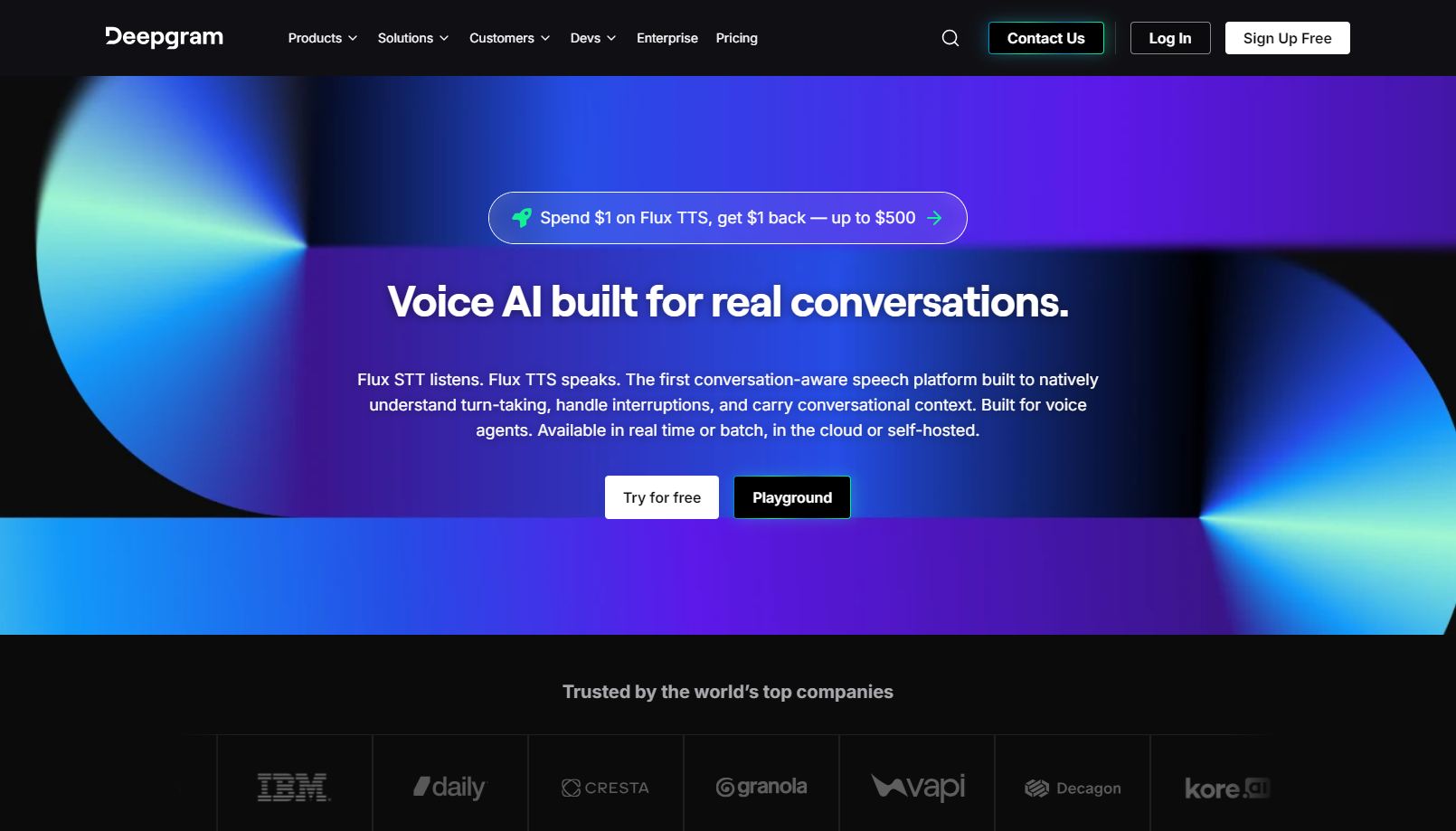
Deepgram is a speech-to-text and voice AI platform specializing in low-latency streaming capabilities. Its Nova family of speech recognition models offers batch transcription and streaming transcription while their Flux speech recognition model is optimized for turn detection in voice agents. Deepgram provides text-to-speech and voice-agent infrastructure as well as speech-to-text capabilities and allows enterprise customers to self-host their deployments.
Key capabilities include:
- Batch and real-time transcription
- Speaker diarization
- Keyterm prompting
- Multilingual transcription
- Voice-agent tooling and text-to-speech capabilities
- Developer APIs and SDKs
Deepgram Pricing
Deepgram charges by the minute of audio. Pay-as-you-go Nova-3 pre-recorded transcription costs $0.0043 per minute (approximately $0.26/hour) for a single language or $0.0052 per minute (approximately $0.31/hour) for multilingual transcription with diarization included. Streaming is $0.0048 per minute (approximately $0.29/hour) under a temporary promotional discount. The standard price is $0.0077 per minute (approximately $0.46/hour). Streaming diarization costs an additional $0.0020 per minute or about $0.12/hour. With the Growth plan, your rates are decreased if you pay upfront annually, with costs beginning at $4,000 per year.
Deepgram vs. AssemblyAI
Both are aimed at developers creating production speech apps, and each has a comparison page where they claim superiority (Deepgram’s, AssemblyAI’s). Independent third-party reviewers have generally concluded the transcribers are neck-and-neck on clean English audio.
Here’s where the products meaningfully diverge: Deepgram has a particularly robust offering around real-time voice AI and streaming infrastructure, plus a self-hosting option. AssemblyAI leads on speech-understanding and LLM capabilities and its Universal model line, and its base batch pricing is lower. Neither is cheap for high-volume conversation audio.
Speechmatics
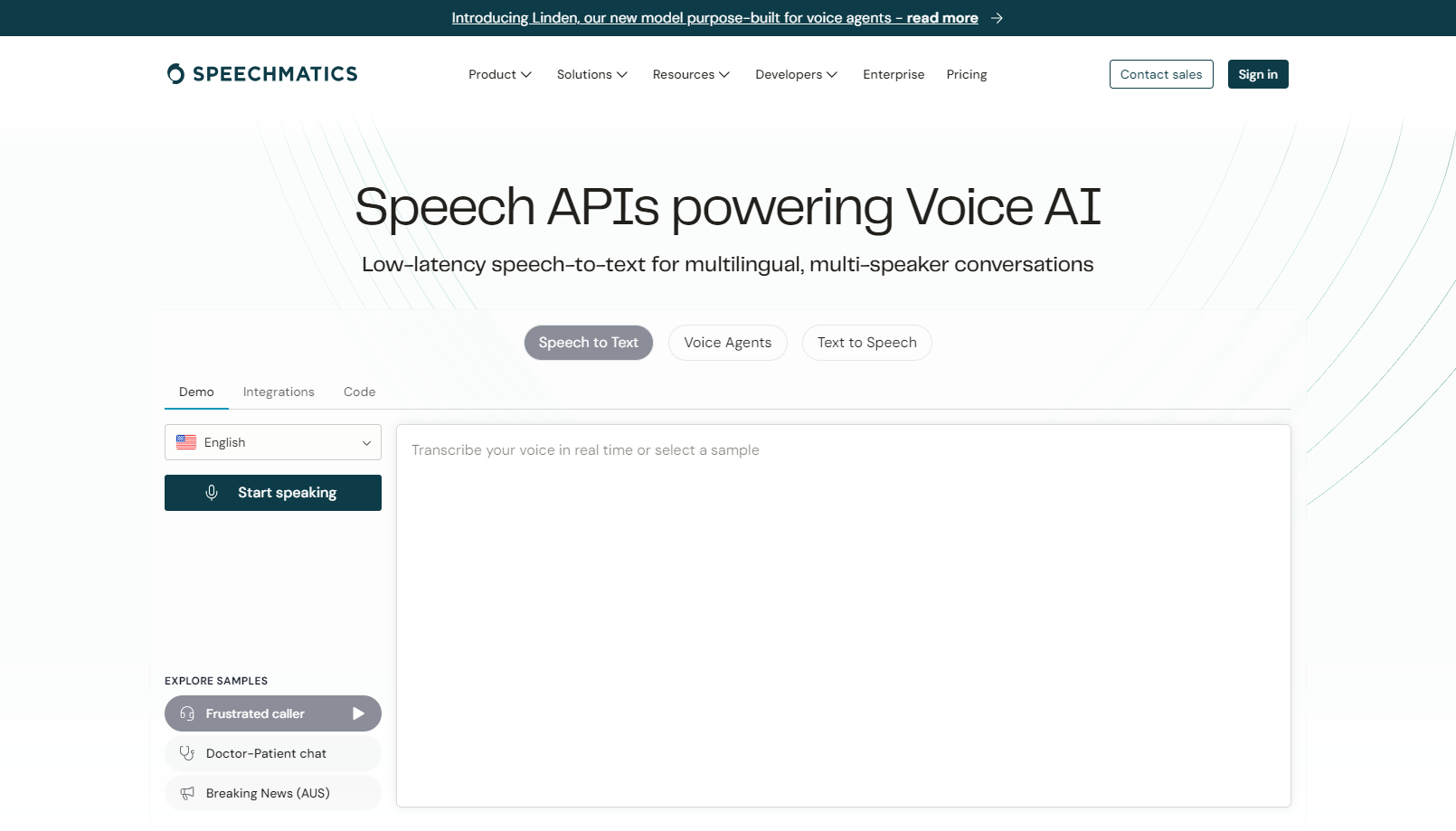
Speechmatics is an established speech recognition provider. It offers both batch and real-time transcription and has multilingual capabilities. Unlike most speech-to-text vendors, Speechmatics can either be deployed on their multi-region cloud platform (US, EU or Australia), or it can be run by enterprise clients in a private cloud, on containers, on a virtual appliance or on-device.
Key capabilities include:
- 55+ languages with wide accent and dialect coverage
- Real-time transcription with sub-second latency
- Speaker diarization
- Automatic language identification, plus Melia 1, a batch multilingual model that handles mid-conversation language switching in a single transcript
- Custom dictionaries
- Available for on-premises, private cloud and on-device deployments
- SOC 2 Type II, ISO 27001, GDPR, and HIPAA certified
Speechmatics Pricing
Speechmatics’ Pro pricing begins at $0.129/hour for the Melia 1 multilingual batch model. Standard Accuracy is $0.24/hour batch or real-time, Enhanced is $0.40/hour batch or $0.43/hour real-time, and diarization is included with all models. If you use more than 500 hours per month for a given model, you are automatically eligible for a 20% discount. If you enable an opt-in program where Speechmatics is allowed to use your data to train its models, you get 33% off. Summaries, sentiment, topics, chapters and translation are additional costs that range from $0.12 to $0.65 per hour.
Speechmatics vs. AssemblyAI
Speechmatics remains a viable option if your deployment architecture or data residency needs are driving factors. For organizations that cannot send their audio to a public-cloud API, both vendors offer alternatives, but Speechmatics offers a wider range: private cloud, containers, a virtual appliance, and on-device deployment, plus cloud regions in the US, EU, and Australia. AssemblyAI is primarily a cloud API with US and EU endpoints, and it offers self-hosted deployment for enterprise customers on a custom-quote basis.
AssemblyAI leans harder into packaged speech understanding products, with a broader suite of low-cost add-ons. If your team only needs cloud transcription, the price comparison depends on the mode. For batch, Speechmatics' Standard ($0.24/hour) and Enhanced ($0.40/hour) cost more than AssemblyAI's Universal-3.5 Pro ($0.23/hr with diarization), though Speechmatics' Melia 1 multilingual model is cheaper at $0.129/hr. For real-time, Speechmatics is cheaper: Standard is $0.24/hr and Enhanced is $0.43/hr with diarization included, compared with $0.57/hr for AssemblyAI's Universal-3.6 Pro Realtime with diarization. AssemblyAI's English-only Universal-Streaming model is $0.15/hour, or $0.27/hour with diarization.
Google Cloud Speech-to-Text
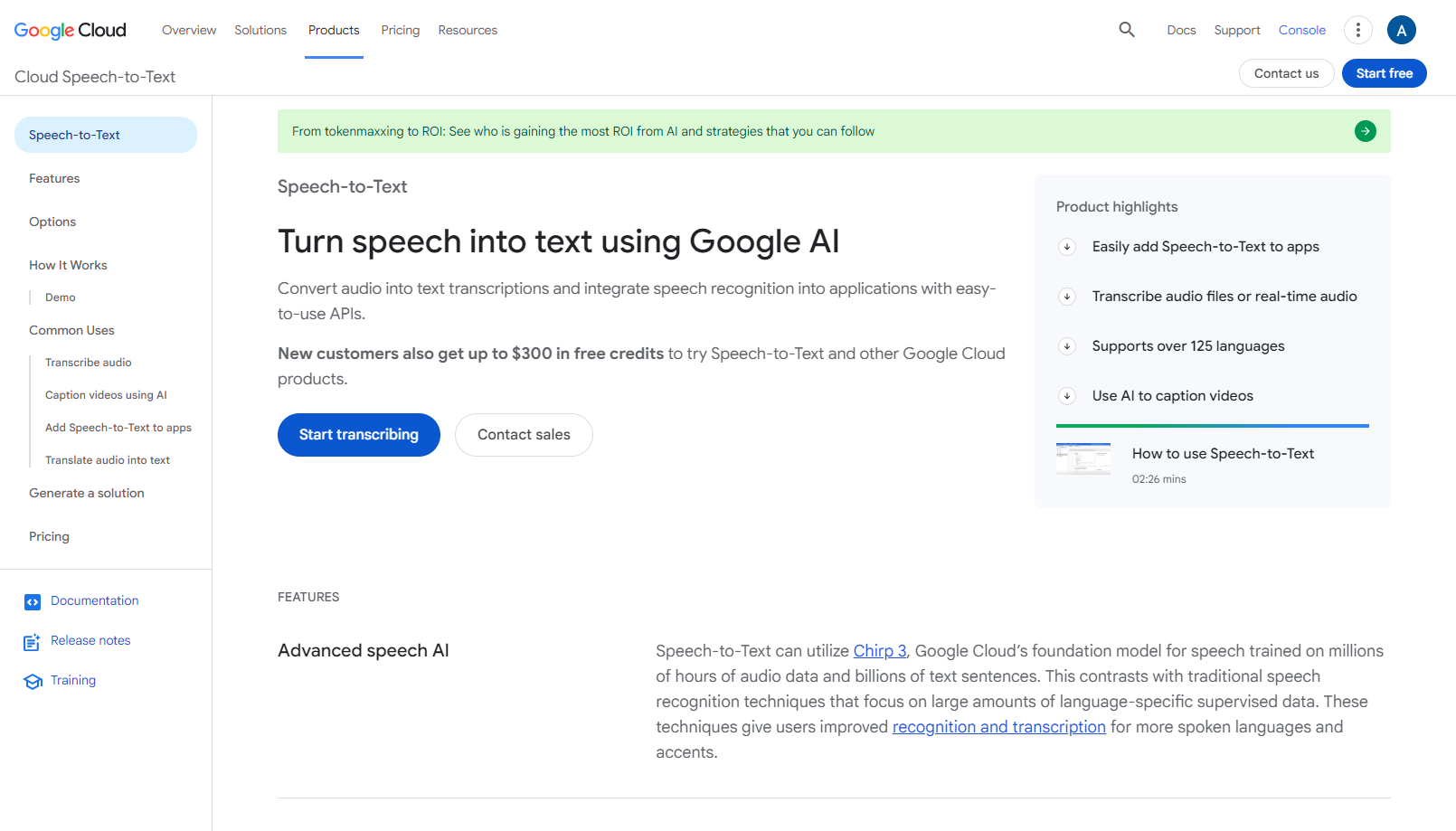
Google Cloud Speech-to-Text is Google Cloud’s speech recognition service, leveraging Google’s Chirp family of models. It’s an excellent choice for businesses already built on Google’s cloud infrastructure and AI platforms, where transcriptions can be automatically passed on to Google Cloud storage, analytics, and Vertex AI solutions.
Key capabilities include:
- 85+ languages and variants
- Batch and streaming recognition
- Automatic punctuation
- Speaker diarization
- Speech adaptation and customized models
- Data residency by region and enterprise cloud integrations
Google Cloud Speech-to-Text Pricing
The standard rate for speech recognition using the V2 API is $0.16/min ($0.96/hour) for the first 500,000 minutes each month. After that, it tiers down based on volume to $0.004/min for more than 2 million minutes per month. Dynamic Batch, which takes up to 24 hours to return results, is priced at roughly $0.003/min ($0.18/hour). V2 requests are billed per second, but multichannel audio is billed separately for each channel, so a one-hour stereo call is billed as two hours.
Google Cloud Speech-to-Text vs. AssemblyAI
Google has a wider cloud ecosystem and language coverage. AssemblyAI has a more focused speech AI developer experience with more built-in speech intelligence, and a lower list price for real-time transcription.
Google only makes sense if transcription is one part of an existing Google Cloud setup, or if your audio can wait until the next day to take advantage of the Dynamic Batch rate.
Amazon Transcribe
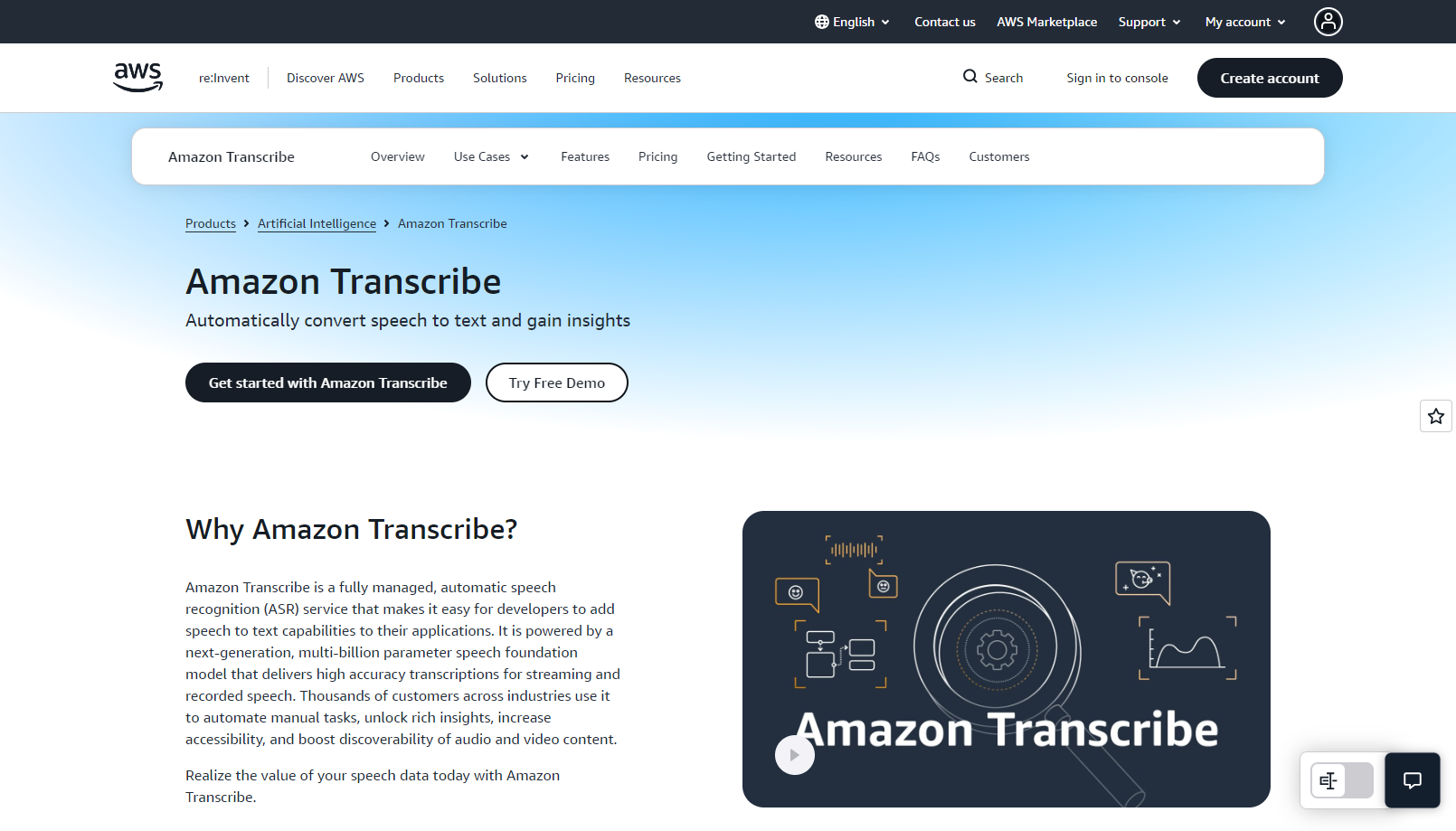
Amazon Transcribe provides automatic speech recognition as a managed service. It naturally integrates with AWS storage, analytics, contact-center (Amazon Connect), and AI services. There are also specialized flavors for call analytics and medical transcription.
Key capabilities include:
- Batch and streaming transcription
- Speaker diarization and channel identification
- Custom vocabularies and custom language models
- PII identification and redaction
- Call Analytics, including sentiment, categorization, and generative call summaries.
- Medical transcription (HIPAA eligible)
- Toxicity detection
- Broad language support
Amazon Transcribe Pricing
Standard batch transcription costs $0.006/min ($0.36/hour) and streaming transcription costs $0.01/min ($0.60/hour) in US East. These prices include diarization, custom vocabularies and language identification. Adding PII redaction will cost $0.0024/min ($0.14/hour) at tier 1. Call Analytics costs $0.03/min ($1.80/hour) at tier 1. Transcribe Medical will cost you $0.075/min ($4.50/hour). Pricing is different depending on the region you choose. All add-ons become cheaper as you increase in volume tiers.
Amazon Transcribe vs. AssemblyAI
AWS has a much larger infrastructure ecosystem overall. AssemblyAI is more niche-focused on speech AI and has a lower list price for standard batch transcription use cases. Amazon Transcribe can simplify architecture and procurement effort for applications that are already significantly invested in AWS, particularly contact centers using Amazon Connect.
OpenAI Whisper
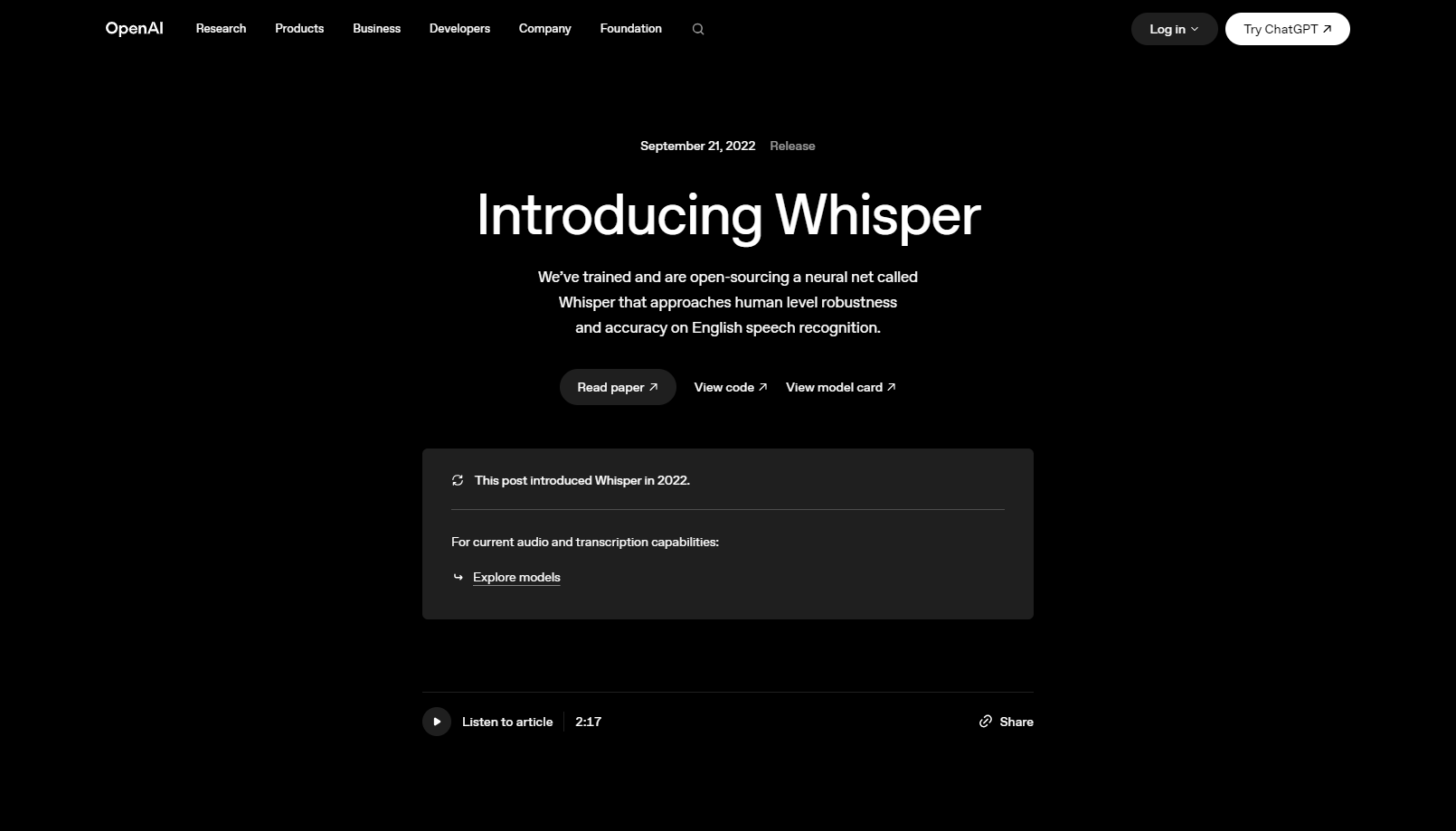
OpenAI Whisper continues to be popular for multilingual speech recognition use cases and self-hosted transcription. As model weights are open source, any team can self-host Whisper on their infrastructure. There are also many third-party tools and optimized implementations built around the model. OpenAI provides newer managed speech-to-text models through its API as well, including gpt-transcribe, the GPT-4o transcription models, and dedicated live-transcription models.
Key capabilities include:
- High-quality recognition in 99+ languages
- Open-source Whisper models allow for self-hosting
- Managed API options including gpt-transcribe, GPT-4o transcription models, live-transcription models, and a diarization model
- Broad ecosystem of third-party tools and implementations
OpenAI Pricing
OpenAI’s newer models cost $0.003/min ($0.18/hour) for gpt-4o-mini-transcribe, $0.0045/min ($0.27/hour) for gpt-transcribe, and $0.006/min ($0.36/hour) for gpt-4o-transcribe.Speaker diarization requires a separate model, gpt-4o-transcribe-diarize, at $0.006/min ($0.36/hour).
Live transcription costs more: gpt-live-transcribe and gpt-realtime-whisper are $0.017/min ($1.02/hour). Self-hosting Whisper doesn’t have a license fee, but you still pay for GPUs, engineering and operations.
OpenAI Whisper vs. AssemblyAI
Whisper can be preferable for teams wanting more control who don't mind hosting models themselves. There are fully managed speech platforms like AssemblyAI that include diarization, prompting and speech understanding out of the box.
Self-hosting Whisper puts the burden of infrastructure, optimization, scaling and maintenance on your team. It also means re-implementing diarization, redaction and analytics yourself, which can negate any savings on the model.
ElevenLabs
ElevenLabs’ core competency has been AI voice generation and text-to-speech products, but their recently launched Scribe line of products takes them into speech-to-text. If you’re looking for both speech-to-text and text-to-a-generated-voice in the same solution from one vendor, ElevenLabs is worth considering.
Key capabilities include:
- Speech-to-text (Scribe v2 for batch, Scribe v2 Realtime for streaming)
- Text-to-speech
- Voice cloning
- Conversational AI, voice agents
- 90+ languages
- Speaker diarization (batch only)
ElevenLabs Pricing
Pricing for ElevenLabs starts at $0.22/hour for batch transcription on Scribe v2, plus $0.05/hour for keyterm prompting and $0.07/hour for entity detection. Scribe v2 Realtime is $0.39/hour; prices decrease on yearly Business plans.
AssemblyAI vs. ElevenLabs
AssemblyAI started out as a speech-to-text and speech-understanding platform. ElevenLabs has a wider array of tools focused on generated voice, of which transcription is only one part.
As such, that history translates into where each tool shines. ElevenLabs is better suited for clear, studio-quality audio like podcasts, voiceovers or otherwise produced media. Its transcription doesn’t perform as well as competitors when it comes to chaotic audio with crosstalk, background noise, messy room tone, etc. Phone calls compressed through phone lines is another area where ElevenLabs falls short. As mentioned above, its real-time model also doesn’t have speaker diarization, making it a poor option for transcribing real time, multi-person conversations.
You’ll have to judge for yourself which is the better fit depending on if your primary need is transcription or voice generation.
How to Choose the Best AssemblyAI Alternative
Evaluate each API on your own audio. Published numbers are often very different from your recordings. Test a statistically valid sample of audio that includes your worst-case conversations (noisiest calls, most participants, etc.) through each remaining API and evaluate word error rate. A tool like Modulate’s side-by-side comparison can give you unaltered results from multiple providers simultaneously.
Calculate total transcription price. Dig deeper than the published rate. Factor in diarization, redaction and any other analytics you’ll require, consider streaming versus batch pricing and see if multichannel audio is charged per channel. Then multiply by your actual monthly throughput.
List prices for each provider’s main pay-as-you-go transcription model, per hour of audio:
| Provider (model) | Batch | Streaming | Speaker diarization | Deployment |
|---|---|---|---|---|
| Modulate Transcribe (Multilingual) | $0.03 | $0.06 | Included | Cloud API |
| AssemblyAI (Universal-3.5 Pro batch; Universal-3.6 Pro Realtime streaming) | $0.21 | $0.45 | +$0.02 batch, +$0.12 streaming | Cloud, self-hosted |
| Deepgram (Nova-3) | $0.26 | $0.29 promotional, $0.46 regular | Included in batch, +$0.12 streaming | Cloud, self-hosted (enterprise) |
| Speechmatics (Standard) | $0.24 | $0.24 | Included | Cloud, on-premises, on-device |
| Google Cloud (V2 standard) | $0.96, or $0.18 with 24-hour Dynamic Batch | $0.96 | Available | Google Cloud |
| Amazon Transcribe (standard) | $0.36 | $0.60 | Included | AWS |
| OpenAI (hosted models) | $0.18 to $0.36 | $1.02 | Separate model ($0.36, batch) | Cloud API, self-hosted Whisper |
| ElevenLabs (Scribe v2) | $0.22 | $0.39 | Batch only | Cloud API |
Most providers offer volume discounts, so compare against a quote for your actual usage.
Consider your needs beyond a text transcript. Do you need to know how something was said? Is a caller tense? Is a voice artificial? Choose a platform that analyzes the audio stream natively rather than one that performs text analytics downstream.
Evaluate latency requirements. Voice agents and live assistance should have sub-second streaming. Analytics on archived calls and transcripts can take advantage of less expensive batch or latency-tiered APIs.
Consider security and privacy. Look for certifications (SOC 2, ISO 27001, HIPAA), data retention and training policies, ability to host in specific regions and whether sensitive data can be redacted from the audio itself and not just the transcript.
Why Modulate Is the Best AssemblyAI Alternative
For teams transcribing real-world conversations at scale, Modulate offers the strongest combination of accuracy and cost.
Affordable transcription prices. Modulate Transcribe starts at $0.025 per hour (batch) and $0.05 per hour (streaming) for English-only transcription. The Multilingual model is $0.03 per hour (batch) and $0.06 per hour (streaming), with diarization included. Compare that to AssemblyAI at $0.23 per hour (Universal-3.5 Pro, batch) and $0.57 per hour (Universal-3.6 Pro Realtime, streaming) with diarization.
Optimized for real-world, messy audio. Modulate Transcribe is trained on over 500 million hours of conversational audio. It specializes in correctly transcribing overlapping speakers, interruptions, accents, and background noise.
Proven performance on public benchmarks. Modulate's Multilingual model ranks #3 on Hugging Face's English Open ASR Leaderboard with an average word error rate (WER) of 4.56%, and its 6.31% WER on the AMI meeting benchmark is the second-lowest of any model on the leaderboard (as of September 2026).
Multiple voice signals from one platform. Emotion, accent, PII/PHI, language, and deepfake detection available through the same API as low-price-point add-ons so you’re not cobbling together multiple vendors.
Redacts PII/PHI from actual audio in real time. Transcribe can return a redacted audio stream as well as a redacted transcript. Modulate detects and redacts over 100 categories of PII and PHI.
Audio-native intelligence, not transcript-first analysis. Velma, Modulate’s Ensemble Listening Model, processes specialized models in tandem to understand what’s being said in real time instead of having one general-purpose model waiting to analyze a transcript after the fact.
A purpose-built path for organizations that need to understand voice. Start with Transcribe today and add fraud, intent and behavior detection through Velma as your understanding of voice expands, all on the same platform.
Ready to compare it on your own audio? Sign up for free API access to Modulate Transcribe.